Featured Aluminium Louvre Doors & Shutter Configurations
Directly fabricated from virgin primary 6063-T5/T6 billet extrusions, our architectural louvre doors balance aerodynamic natural airflow, solar shading, acoustic mitigation, and maximum weather tightness.
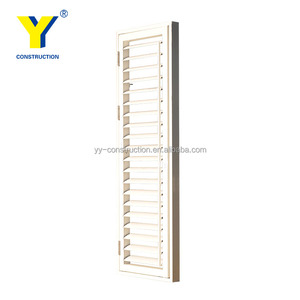
Louvered French Doors / Plantation Shutters Fixed Exterior Door
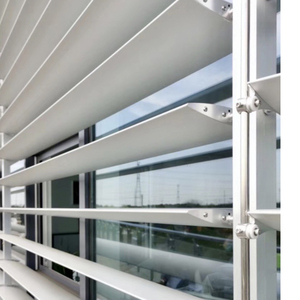
Adjustable Louver Openable Privacy Screen Shutter System
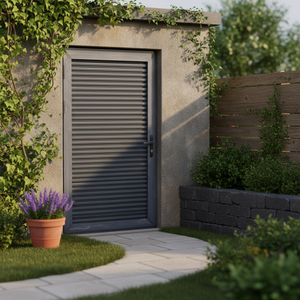
RG60C Thermal Break Aluminium Louver Casement Entry Door
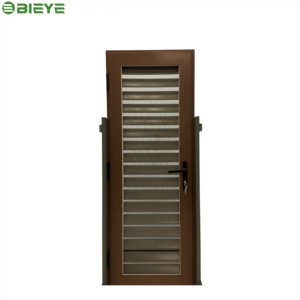
Fully Blackout Heat-Insulating Luxury Alloy Louver Door
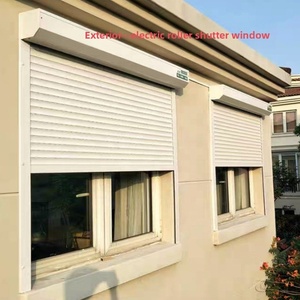
European-Style Folding & Sliding Motorized Louver Doors
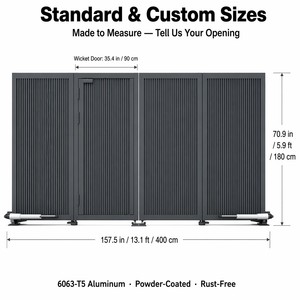
Custom Louver Driveway Swing Gate & Integrated Wicket Door
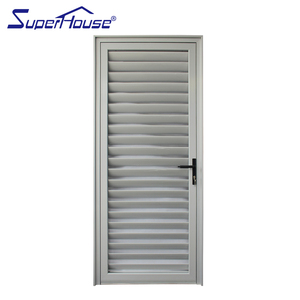
AS 2047 & NFRC Standard Aluminium Louver Hinged Door
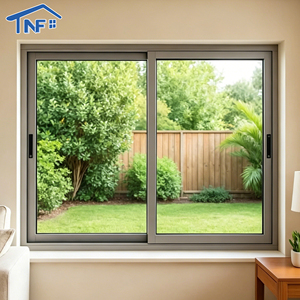
Hurricane Impact Double Glazed & Integrated Shutter System
Engineering Principles of Architectural Aluminium Louver Systems
Architectural aluminium louvre doors occupy a mission-critical position within modern envelope design. Unlike standard glazed doors, louvered configurations must satisfy opposing mechanical requirements: achieving high free-area ventilation ratios while maintaining uncompromising resistance against wind-driven torrential precipitation, structural wind buffeting, and acoustic transmission.
In international engineering procurement, specifying louvre systems requires rigorous metallurgical analysis. At DERCHI’s 180,000 m² Foshan manufacturing base, production begins with high-purity virgin 6063-T5 and structural 6063-T6 architectural aluminium alloys. Extruded with a uniform wall thickness of 1.8mm to 3.0mm, our profiles resist the torsional racking forces common in large-span commercial apertures and high-cycle industrial utility enclosures.
When louvres are installed along coastal strips or tropical cyclone paths—such as the eastern seaboard of Australia, the Caribbean, or Southeast Asia—inferior recycled aluminium alloys suffer from intergranular corrosion and fatigue fractures around pivot pins. By maintaining silicon, magnesium, and iron tolerances strictly within ASTM B221 specifications, our extruded blades guarantee ultimate tensile strengths surpassing 205 MPa.
Aerodynamic Blade Geometry & Ingress Defense
Our R&D engineering department utilizes Computational Fluid Dynamics (CFD) modeling to formulate dual-stage and chevron louver blade profiles. By introducing an internal drainage capillary trough within each extrusion tier, incoming wind-driven rain is decelerated, collected, and gravimetrically channeled through concealed vertical jamb weeping paths, achieving zero internal spray penetration up to 300 Pa static water pressure.
Comprehensive Architectural Louver Door Benchmark
Evaluate critical structural parameters across our primary product classifications to ensure compliant specification in residential, industrial, and cyclonic environments.
| Performance Characteristic | Fixed Plantation Shutter | Adjustable Operable Louver | RG60C Thermal Break Louver | AS 2047 Certified Cyclonic Door |
|---|---|---|---|---|
| Alloy & Temper | 6063-T5 Structural Billet | 6063-T6 Hardened Alloy | 6063-T5 with PA66 Insulator | 6063-T6 High-Tensile Heavy Wall |
| Aerodynamic Free Area | 48% to 58% Continuous | 0% (Closed) to 76% (Open) | 35% to 45% Acoustically Baffled | 42% Engineered Baffled |
| Water Ingress Limit | 150 Pa Hydrostatic Head | 250 Pa Compression Sealed | 350 Pa Triple Gasket Tier | 450 Pa Dynamic Pressure PASS |
| Wind Loading Capacity | Serviceability: 1800 Pa | Serviceability: 2400 Pa | Serviceability: 3000 Pa | Ultimate Limit: > 4500 Pa (N6) |
| Surface Finish Spec | Qualicoat Class 1 (60µm) | Qualicoat Class 2 / PVDF | AkzoNobel Marine Powder | AAMA 2605 3-Coat Fluorocarbon |
| Hardware Integration | 304 Stainless Hinges | Concealed Heavy-Duty Gearbox | Multi-Point European Groove | Austenitic 316 Marine Hardware |
The Next Decade in Aluminium Louver Sourcing: 2026–2035
Global building envelopes are undergoing profound legislative and environmental transformations. General contractors, facade engineers, and developers must adapt procurement strategies to keep pace with decarbonization and extreme climate shifts.
Thermal Break & Low-Carbon Billets
Standard cold-bridge louver assemblies are rapidly being phased out of European and Oceanic commercial building codes due to condensation damage and excessive HVAC cycling. Future procurement pivots entirely toward polyamide thermal breaks (PA66GF25) integrated inside extruded door stiles. Concurrently, tier-1 developers mandate Scope 3 emission declarations, driving demand for billets smelted with renewable hydro energy carrying certified embodied carbon below 4.0 kg CO2/kg Al.
BMS-Automated Micro-Climatic Actuation
Static louvers are yielding ground to smart, motorized solar-responsive louvre doors. Integrating quiet brushless DC 24V linear motors within the head frame allows facade fenestrations to sync directly with central Building Management Systems (BMS). Using BACnet or Modbus protocols, blades articulate in micro-increments according to real-time sun angles and barometric rain sensors, dramatically lowering peak indoor solar thermal loading by up to 64%.
Dual-Defense Cyclonic & Bushfire Systems
Escalating weather instability has unified architectural demand across Australasia and the southern United States for combination systems. Modern specifications demand AS 3959 BAL-40 / BAL-FZ (Flame Zone) ember-screen integration alongside AS 2047 N6 cyclonic impact credentials. Forward-thinking procurement officers are consolidating suppliers into single-source industrial groups capable of delivering complete factory-prehung, pre-glazed, and performance-certified door leaves.
Why Global Importers Partner with Our Foshan Manufacturing Base
Ranked among China’s Top 10 premium architectural fenestration manufacturers, Guangdong Dejiyoupin Doors and Windows Co., Ltd. (DERCHI) represents 25+ years of production excellence. Operating an integrated 180,000 m² smart production ecosystem in Foshan, Guangdong, we control every single manufacturing node—from raw alloy die development to automated machining, powder coating, and final crate assembly.
Single-Source Responsibility
From aluminium extrusion, punching, milling, and surface treatment to hardware rigging, our in-house control eliminates subcontractor markups and quality deviations.
Free CAD & BIM Coordination
Our 30+ person senior engineering department delivers comprehensive shop drawings, structural section calculations, and BIM models tailored to project schedules before cutting metal.
Export-Grade Heavy Crating
Protected with multi-layered protective films, shock-absorbing corner buffers, and fumigated steel-strapped solid plywood crates that pass strict biosecurity quarantine customs.
AEST / NZST Synchronized Teams
English-fluent project engineers working during Australia, New Zealand, and Pacific business hours provide instant technical coordination and responsive factory video inspections.
Frequently Asked Questions: Sourcing Aluminium Louvre Doors from China
Critical technical insights addressing compliance verification, quality control checks, surface longevity, and international freight logistics.
How do we verify AS 2047 and international building code compliance before shipping?
DERCHI provides genuine, fully traceable NATA-accredited third-party laboratory test reports validating AS 2047 mechanical testing (Deflection, Air Infiltration, Water Penetration Resistance, and Ultimate Strength up to N6 / 4500Pa). For North American projects, we furnish NFRC and AAMA-certified thermal calculations and air leakage verification data. Every production batch is stamped with lot traceability markings corresponding directly to the project mill test certificates (MTC) and quality compliance dossiers.
What surface coating standard is required for beachfront and coastal salt-spray exposure?
For sites situated within 1,000 meters of open marine coastlines, standard architectural powder coatings (AAMA 2603) will fail prematurely due to filiform and pitting corrosion. We mandate Qualicoat Class 2 hyper-durable fluoropolymer powders (such as AkzoNobel Interpon D2525) or 3-coat liquid PVDF (polyvinylidene fluoride) complying with AAMA 2605. Alternatively, our 25-micron anodic oxidation Class I finishes pass 3,000-hour neutral salt-spray (ASTM B117) exposure without surface degradation or chalking.
Can you engineer operable louvers with integrated flyscreens and security grilles?
Yes. Our custom architectural extrusion profiles support sub-frame internal tracks engineered specifically for high-tensile 316 marine-grade stainless steel security mesh (0.8mm wire thickness, knife-shear resistant according to AS 5039/5041) or ultra-fine micro-perforated insect screening. The screen assembly is recessed directly behind or in front of the pivot blades without disrupting internal dual-linkage operator arms or motorized actuators.
What is the standard manufacturing lead time and sea freight arrangement for Oceanic ports?
Standard factory fabrication timelines run between 25 and 35 calendar days following formal architectural CAD shop drawing sign-off and color chip verification. Direct sea container shipping from Foshan, Nansha, or Shenzhen ports requires 14–18 days to Sydney, Melbourne, and Brisbane, 21 days to Fremantle/Perth, and approximately 18–22 days to Auckland or Suva. We manage complete export customs documentation, ISPM 15 fumigation compliance, packing manifests, and bill of lading generation.
Prepare Your Project Door Schedule for Factory Estimation
Connect directly with our Foshan engineering desk. Share your elevation drawings, window/door schedules, or architectural specifications to receive complete structural CAD shop drawings and direct tier-1 manufacturer pricing.