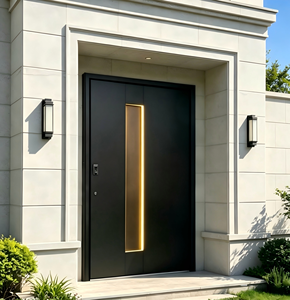
Precision Engineered Range
High-Performance Fenestration & Entrance Systems
Explore our premium architectural series tested to dynamic cyclical loads, salt-spray corrosion thresholds, and severe climatic parameters.
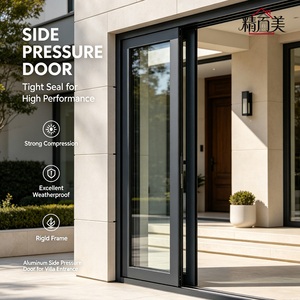
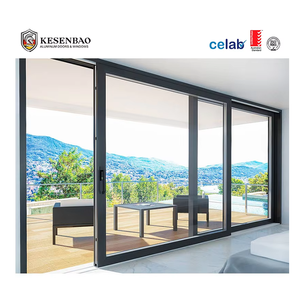
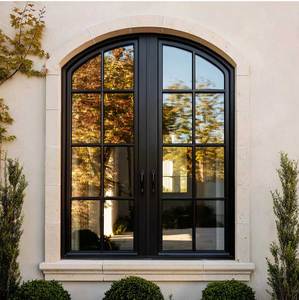
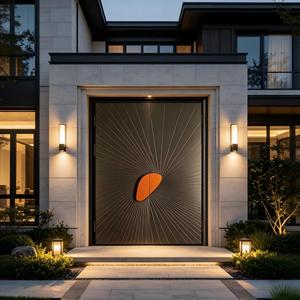
Technical White Paper
Engineering Anatomy: Architectural Aluminium-Wood Composite Windows
A structural breakdown of composite fenestration: thermodynamic stabilization, differential expansion coefficient mitigation, and Passivhaus performance metrics.
The contemporary architectural fenestration market is observing a definitive paradigm shift away from singular-material structural framing. While non-thermal unplasticized polyvinyl chloride (uPVC) lacks dimensional stability across expansive spans, and monolithic structural aluminium profiles exhibit elevated thermal bridging coefficients ($U_f > 3.5 \text{ W/m}^2\text{K}$), modern engineered aluminium-clad wood window and facade assemblies reconcile structural rigidity with organic thermal dampening. To navigate global building efficiency directives—such as North America's ASHRAE 90.1, the European Union's Energy Performance of Buildings Directive (EPBD), and Australia’s National Construction Code (NCC 2022)—procurement professionals must evaluate the microscopic mechanics of the aluminium-wood matrix.
1. The Thermodynamic Decoupling Mechanism (Aluminium Cladding vs. Solid Timber Core)
The fundamental structural challenge of marrying exterior powder-coated aluminium alloys (typically 6063-T5 or 6063-T6) with interior multi-laminated wood timbers (such as certified Nordic Larch, White Oak, or Radiata Pine) lies in their divergent coefficients of linear thermal expansion. Aluminium expands and contracts at approximately $23 \times 10^{-6}/\text{K}$, whereas perpendicular-to-grain wood exhibits volumetric alterations primarily linked to atmospheric hygroscopic equilibrium ($3.5 \times 10^{-6}/\text{K}$ along the grain). If chemically bonded with non-elastic agents, shear failure inevitably manifests within dynamic seasonal zones.
Premier tier-one manufacturers solve this through engineered floating interlocking nylon-fiberglass composite clips (polyamide PA66 GF25). These dynamic anchors isolate the exterior weathering shield from the internal load-bearing timber, accommodating independent micro-expansion while establishing a continuous pressure-equalized rear-ventilation cavity. This interstitial chamber drains incidental micro-condensation while preventing internal wood moisture stagnation, completely eliminating rot and dimensional warping.
Thermal Break Isolation
Multi-chamber continuous PA66 thermal barriers reduce conductive bridge transmission, enabling overall system U-values down to $U_w \le 0.79 \text{ W/m}^2\text{K}$ suited for Passivhaus verification.
Extreme Wind Load Resistance
Reinforced hollow profile wall thicknesses reaching $2.0\text{mm} - 3.0\text{mm}$ fulfill AS 2047 structural deflection standards at N6 classification under cyclic wind pressures exceeding 4500 Pa.
Multi-Barrier Acoustic Attenuation
Co-extruded vulcanized EPDM triple-seal gaskets paired with asymmetrical acoustic laminated insulated glass units (IGUs) achieve sound transmission loss performance upwards of $R_w + C_{tr} \ge 43\text{ dB}$.
Strategic Procurement
Future Sourcing & Procurement Trends: 2026–2030
Essential market trajectories informing high-volume commercial specifications, hotel development tenders, and luxury private residential mandates.
Decarbonization & Low-Carbon Extrusions
International environmental ratings (LEED v4.1, BREEAM) increasingly penalize carbon-heavy aluminum sourcing. Specifiers demand ASI-certified (Aluminium Stewardship Initiative) hydro-smelted primary billets combined with FSC-certified interior lamination lumber, requiring Environmental Product Declarations (EPDs) down to cradle-to-gate lifecycle metrics.
Oversized Clear Openings & Heavy-Payload Pivot Systems
The convergence of interior and exterior architectural expressions demands oversized sashes reaching heights beyond 4.5 meters and payloads exceeding 600 kg. High-torque concealed hydraulic pivots, stainless-steel multi-roller tracking systems, and carbon-fiber reinforcement ribs have graduated from niche custom builds to standardized volume engineering schedules.
IoT-Enabled Structural Mechatronics
Smart envelope integration has moved beyond localized contact sensors. Current institutional procurement requires windows with embedded micro-actuators connected directly to centralized Building Management Systems (BMS), executing automated purge ventilation according to volatile organic compound (VOC) and indoor CO2 load thresholds.
DERCHI Industrial Infrastructure
Why Tier-1 Developers & Glazing Importers Consolidate with DERCHI
Operating from Foshan's core manufacturing cluster, Guangdong Dejiyoupin Doors and Windows Co., Ltd. controls the complete vertical processing chain.
180,000 m² Mega Base
Advanced fully automated CNC multi-axis milling, profile cutting, automated timber drying chambers, and robotic dust-free coating workshops operated by 600+ skilled personnel.
AS 2047 N6 Wind Certified
Accredited air infiltration, high-velocity water penetration (up to 700 Pa static pressure), and ultimate cyclonic deflection testing validated for Australasian coastal exposures.
Free CAD & BIM Services
Our dedicated engineering department generates fully customized shop drawings, thermal simulation reports, and anchor force calculations within 48 hours of initial schedule submission.
European Certified Hardware
Engineered hardware partnerships with industry leaders including Siegenia, Roto, Hoppe, and custom high-security multipoint locks delivering 100,000+ lifecycle operations.
Export Engineered Logistics
FCL and LCL timber-free fumigated crating with anti-moisture desiccant packaging, optimized for trans-oceanic passage directly to Australia, New Zealand, and global ports.
Architectural Knowledge Base
Frequently Asked Technical & Sourcing Questions (FAQ)
Essential guidance on performance criteria, moisture content thresholds, international compliance, and lead times.
What internal timber species and moisture contents are specified?
We utilize multi-layer finger-jointed laminated timbers including European White Oak, Nordic Larch, and North American Pine. Kiln drying brings timber equilibrium moisture content precisely down to 8%–12%, eliminating post-installation shrinkage or splitting in conditioned spaces.
How does DERCHI prevent differential thermal shear between wood and aluminum?
Differential thermal movements are addressed by avoiding direct rigid screw fastenings. Instead, German-engineered heavy-duty polyamide sliding connection clips allow exterior aluminum profiles to thermally oscillate along longitudinal axes without imparting structural stress onto internal timber profiles.
Do composite systems comply with regional wind & water ingress codes?
Yes. DERCHI fenestration profiles are systematically engineered and tested to satisfy AS 2047 (N6 wind category ratings over 4500 Pa), North American AAMA/WDMA/CSA 101/I.S.2/A440-11, and European CE EN 14351-1 standards. Certified lab reports accompany each formal bid proposal.
What surface treatment coatings are applied to exterior aluminum cladding?
Exterior extrusions receive AkzoNobel architectural powder coatings (25-year gloss retention) or 3-coat fluoropolymer (PVDF) finishes exceeding AAMA 2605 requirements. These coatings maintain chemical resistance against marine saline assault and intensive UV degrade.
Can customized hardware, concealed hinges, and smart locks be embedded?
Our internal CNC machining centers route profiles to accept German multipoint locking systems, motorized tilt-and-turn concealed scissor gearings, and smart biometric / home-automation interfaces without breaking thermal breaks or compromising acoustic gaskets.
What are the standard manufacturing lead times and ocean logistics provisions?
Standard fabrication spans 25 to 35 operational days from final approved CAD shop drawings. Marine-safe, export-grade fumigated solid plywood crating with corner edge dampeners ensures zero damage across trans-ocean container shipments to ports in Sydney, Melbourne, Auckland, and worldwide.
Engage with Our Structural Fenestration Engineering Group
Submit your architectural window schedule, CAD elevations, or custom project brief. Receive comprehensive takeoff proposals, structural anchor calculations, and full shop drawings within 48 hours.
Inquire Now