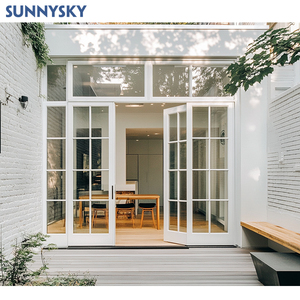
Sunnysky NFRC Customizable Etched Glass Windows Aluminum Clad Wood Bevelled Glass Window And Door
NFRC-certified dual exterior seal design with customizable art-etched insulated glazing for custom luxury villas and commercial estates.
Engineered to bridge aesthetic heritage warmth with heavy-duty weather integrity. Each window profile incorporates continuous multi-point lock systems, structural nylon thermal barriers, and precision CNC-milled hardwood timber cores.
NFRC-certified dual exterior seal design with customizable art-etched insulated glazing for custom luxury villas and commercial estates.
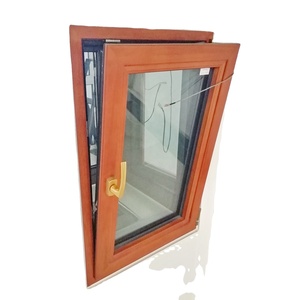
Seamless composite profiles engineered with concealed heavy-duty track rollers, providing silent horizontal glide and optimal solar protection.
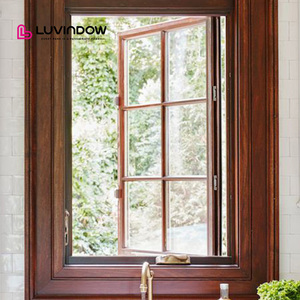
German Siegenia hardware configuration supporting both micro-ventilation tilt and broad 90° inward turn for easy maintenance and acoustic damping.
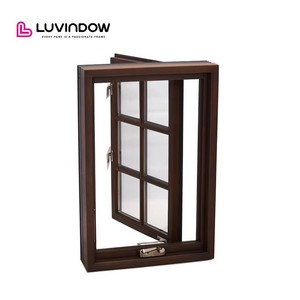
Smooth fold-away Truth hardware crank operators coupled with multi-chamber weatherstripping for hurricane-grade water and wind resistance.
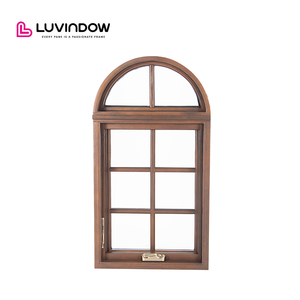
Meets demanding North American energy ratings with double-paned warm edge spacers, argon filling, and high-impact exterior architectural alloy casing.
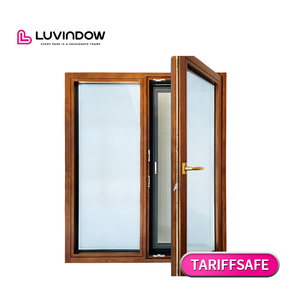
Engineered for passive house standards featuring triple-layer Low-E insulated glazing units, yielding exceptionally low U-values down to 0.79 W/m²K.
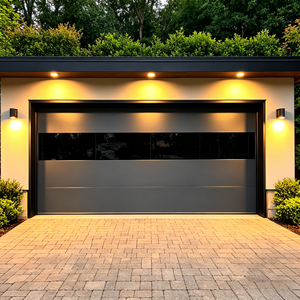
Commercial grade extruded aluminum framework integrated with frosted privacy security glass; built to harmonize facade lines with entry and window schedules.
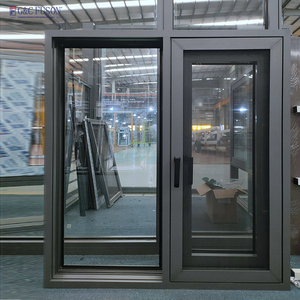
Heavy-duty structural wall thickness combined with multi-chamber insulated break systems, tailored for high-wind coastal high-rise and residential complexes.
Ranked consistently among China's Top 10 High-End Architectural Enclosure Manufacturers, we control raw ingot extrusion, multi-axis computerized timber milling, robotic multi-coat finishing, and ISO 9001 certified batch tracking under one unified roof.
From raw billet aluminum profile extrusions (6063-T6) to finger-jointed laminated wood preservation, our internal lines minimize supplier dependencies and compress standard OEM production cycles by up to 35%.
Tested rigorously up to Australian Standard AS 2047 N6 wind loads and American NFRC thermal performance ratings. Full test logs, structural calculation sheets, and third-party certificates are bundled with each container shipment.
Our dedicated in-house facade engineering department translates architectural elevations into accurate millimeter-precise CAD shop drawings and Revit BIM parametric models, mitigating on-site installation misalignments.
Decades of export competence ensure compliant ISPM-15 treated wooden crating, desiccant-loaded ocean containers, and consolidated scheduling directly to key ports across North America, Europe, Australia, and New Zealand.

Our 180,000 m² complex in Shishan Town, Foshan, leverages German multi-axis CNC routing equipment, automatic profile electrostatic fluorocarbon coating lines, and temperature-controlled timber stabilization chambers.
As net-zero operational carbon mandates and stringent international building envelopes transform specifications, aluminum clad wood windows have emerged as the premier choice for architects balancing biophilic interior wellness with resilient commercial exterior envelopes.
According to global fenestration market projections, aluminum-clad timber systems are registering an annual compound growth rate exceeding 6.8% in luxury residential and institutional sectors across North America, Australasia, and Northern Europe. The transition away from unclad solid timber and cold uninsulated aluminum is fueled by three core structural vectors: extreme lifecycle weather resistance, decarbonization demands requiring bio-based structural timber, and smart home envelope integration.
Building codes such as Title 24 (California), NCC 2022 (Australia), and EnEV (Germany) necessitate whole-window thermal transmittance (Uw) below 1.0 W/m²K. Aluminum clad wood combines low thermal conductivity timber (λ ≈ 0.13 W/mK) with external polyamide thermal breaks, outperforming standard thermal break aluminum frames by up to 40% in heat retention.
Procurement directors operating in hurricane belts or coastal zones (e.g., Florida, Sydney, the Caribbean) are abandoning unclad wood due to rot and termite exposure. Modern aluminum cladding utilizes 1.8mm–2.2mm architectural 6063-T6 aluminum treated with Qualicoat Class 2 or AAMA 2605 70% PVDF fluorocarbon coatings, maintaining pristine surface stability through 3,000-hour salt-spray exposure.
Historical composite failures stemmed from glued aluminum-wood lamination tearing itself apart due to divergent linear thermal expansion coefficients. Leading OEM manufacturing now enforces floating composite clips with nylon-66 isolators, permitting independent thermal movement between metal and wood without frame warpage or seal failure.
| Engineering Attribute | DERCHI OEM Al-Clad Wood | Standard Thermal Break Aluminum | Traditional Solid Timber | Commercial uPVC Profiles |
|---|---|---|---|---|
| Whole-Window Uw Value | 0.79 – 1.20 W/m²K (Superior) | 1.60 – 2.40 W/m²K (Moderate) | 1.30 – 1.80 W/m²K (Good) | 1.30 – 1.90 W/m²K (Good) |
| Acoustic Isolation (Rw/STC) | Up to 45 dB (Dense Timber Core) | 32 – 36 dB (Hollow Resonant) | 36 – 40 dB (Natural Dampener) | 30 – 34 dB (Flexible Core) |
| Exterior Weathering Life | 50+ Years (Zero Wood Exposure) | 30 – 40 Years (Subject to Anodize Fade) | 5 – 8 Years (Requires Recoating) | 15 – 20 Years (UV Embrittlement) |
| Structural Rigidity for Oversized Sashes | High (Extruded Alloy + Triple-lam Wood) | High (Subject to deflection) | Moderate (Subject to creep & sag) | Low (Requires steel reinforcing) |
| Biophilic Aesthetics & Resale Value | Luxury Real Hardwood (Oak, Pine, Teak) | Cold Metallic Interior | Authentic Timber Atmosphere | Plastic Synthetic Texture |
Everything commercial estimators, developers, and project architects need to understand about specifying, customizing, testing, and importing aluminum-clad timber windows.
Direct factory pricing, dedicated fenestration engineers, free CAD shop drawings, and tailored performance calculations for your next luxury project or commercial development.
Contact Us