Choosing the right Aluminium Washroom Door in 2026 requires more than comparing finishes and prices. Global buyers must consider moisture, traffic, cleaning routines, privacy, installation, and long-term maintenance. A door placed beside a busy swimming pool faces different demands from one used in a quiet office. Salt air, harsh detergents, and constant contact can expose weak materials quickly.
This guide examines practical door types, including solid aluminium, honeycomb-core, compact laminate-faced, and framed designs. Each option offers different strengths in weight, rigidity, impact resistance, appearance, and repairability. Experience from commercial interiors shows that hinges, locks, edges, and wall fixing often matter as much as the door panel. Small details matter.
Reliable purchasing also requires clear specifications. Buyers should review aluminium grade, coating method, panel thickness, hardware quality, warranty terms, and available replacement parts. Local building, fire, accessibility, and sanitation requirements should be checked before production. Requirements differ by country and project type. No single door fits every washroom.
A low price can become expensive when hinges corrode or panels warp. That assumption deserves careful review. Samples, finish cards, and installation drawings can reveal problems before shipment. However, product data is not always complete, and suppliers may describe similar constructions differently. Ask precise questions. Request test information where performance claims affect safety or service life.
The sections ahead help architects, contractors, distributors, and facility owners compare aluminium washroom door types with greater confidence. The goal is not to promote one universal solution. It is to match a dependable door system with real site conditions, expected use, and responsible purchasing decisions.
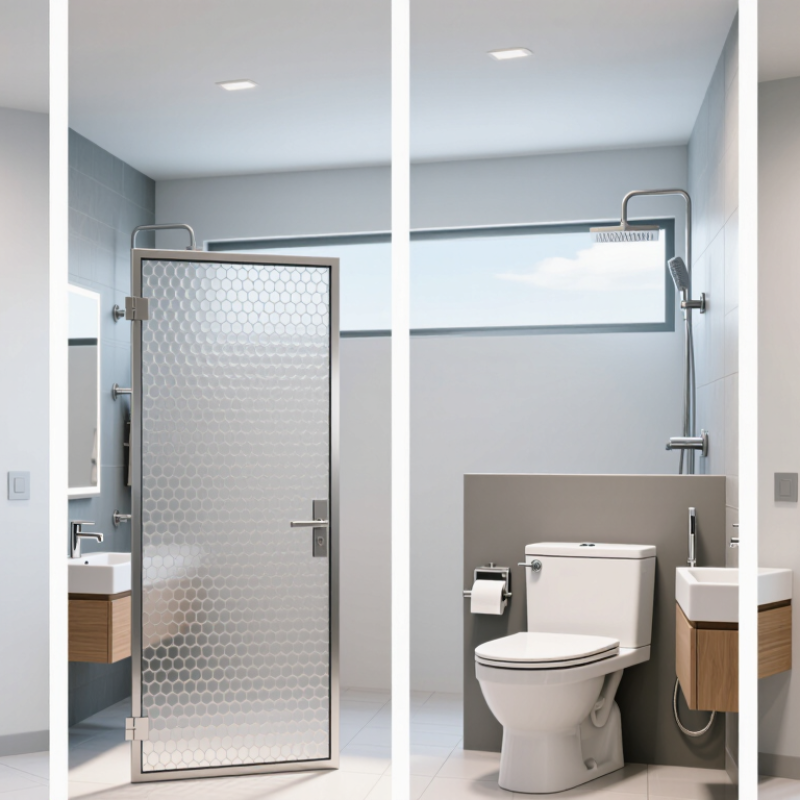
Aluminium washroom doors balance low weight, moisture resistance, and practical maintenance. Unlike untreated steel, aluminium does not readily rust in humid interiors. Its powder-coated or anodized surface can handle frequent cleaning when installers follow the finish supplier’s guidance. Common options include hinged, sliding, folding, and compact laminate-faced aluminium doors. Each type suits different circulation needs. Hinged doors need clear swing space. Sliding doors save floor area but require clean, stable tracks.
In 2026, buyers are showing stronger interest in slim frames, concealed hardware, and warmer surface tones. Soft bronze, charcoal, sand, and muted silver can make public washrooms feel less clinical. Matte textures also reduce visible fingerprints.
Touchless access is becoming more relevant, especially in busy facilities. However, sensors need reliable power, simple manual release, and accessible maintenance points. A beautiful system fails quickly when technicians cannot reach its components.
Acoustic privacy is another design priority. Sealed edges and tighter clearances can reduce sound leakage, although they cannot create complete soundproofing. Recycled aluminium content is useful, but buyers should request verifiable material data instead of trusting vague claims. I have seen elegant doors perform poorly because drainage was ignored near the threshold. Small details matter. Designers should check ventilation, cleaning chemicals, user traffic, and local accessibility requirements before selecting a door. Not every 2026 trend deserves approval. A durable, repairable door may serve better than a fashionable one.
Aluminium washroom doors usually fall into four practical types: framed swing, sliding, folding, and louvered doors.
Framed swing doors suit hotels, offices, and schools because they provide familiar access and simple maintenance.
Sliding doors save corridor space, especially in compact public facilities.
Folding doors work well in narrow cubicles, but their hardware needs careful alignment.
Louvered doors improve airflow, although they offer less visual privacy.
No type wins every site.
The International Aluminium Institute reports that recycled aluminium requires about 5% of the energy used for primary production. This supports low-carbon procurement when recycled content is verified. UNEP’s 2024 Global Status Report states that buildings and construction produced about 37% of global energy-related emissions in 2022. Door selection is small, but repeated across large projects, it matters.
Specifications should check alloy grade, coating thickness, corrosion resistance, hinge cycles, and accessible clear width. EN 16005 or local accessibility rules may also influence powered or sliding systems.
Tips:
Request full-size samples before approval. Test doors under wet, high-traffic conditions. Ask for documented recycled content and coating performance. Avoid choosing only by price. A lightweight panel may reduce shipping costs, yet weak hinges can increase maintenance. This is an easy detail to overlook. Project conditions still decide the best type.
In 2026, aluminium washroom doors are moving toward lighter, cleaner, and more durable designs. From project experience, 6063-T5 aluminium offers a practical balance between strength, weight, and corrosion resistance. It suits humid bathrooms, schools, offices, and transport facilities. Recycled aluminium can support sustainability goals, but buyers should verify declarations and material certificates. Not every recycled-content claim is equally reliable.
Finishes affect both appearance and service life. Anodized surfaces provide a firm metallic look and resist everyday abrasion. Powder coatings offer broader colors, including soft grey, white, and dark bronze. Proper pretreatment matters. Without it, moisture may undermine adhesion around edges and cut-outs. That detail is often underestimated. Satin textures can also hide fingerprints better than high-gloss surfaces.
Hardware must match the door’s traffic level. Stainless steel hinges, adjustable legs, indicator bolts, and concealed fixings help maintain stable operation. For high-use projects, test the complete door set, not only individual parts. Check impact resistance, cleanability, privacy function, and accessibility requirements for the target market. Seals can reduce noise and light gaps, while ventilation gaps help control moisture. I have seen attractive doors fail because weak hardware was selected. Performance should be checked after installation, not assumed from a product sheet. Local conditions still matter. Salt air, harsh cleaners, and uneven walls can change the result.
Materials, finishes, hardware compatibility, and performance features
The chart compares common aluminium washroom door configurations using indicative industry performance scores from 1 to 5. Powder-coated and anodized finishes are widely used for moisture-prone interiors, while PVDF finishes are typically selected for demanding environments requiring stronger color and weathering resistance. Scores consider corrosion resistance, finish durability, cleaning ease, hardware compatibility, and suitability for high-traffic washrooms.
Choosing aluminium washroom doors starts with the building’s daily pressure. Busy airports and shopping centres need strong, moisture-resistant doors with reliable hinges and easy-clean surfaces. Fully aluminium doors suit wet areas, coastal sites, and facilities requiring frequent washing. Aluminium-framed doors with compact laminate panels can provide privacy with a lighter appearance. They also allow practical colour and finish choices.
Office washrooms usually need quiet operation and a refined look. Schools and sports centres need impact resistance, simple maintenance, and safe finger protection. Healthcare environments require smooth, non-porous surfaces and careful cleaning compatibility. Always check local accessibility, fire, ventilation, and hardware requirements before ordering. A door can look suitable but fail during installation. Site measurements matter.
Tips: Ask for sample sections, not only photographs. Test hinges, locks, and clearance with the actual wall condition. Confirm aluminium thickness, panel core, edge protection, and replacement availability. Coastal air may demand stronger corrosion protection. Small details matter. A perfect door rarely exists; the best choice balances hygiene, privacy, durability, budget, and local service. Supplier claims should be checked against test reports and project references.
Global buyers in 2026 are comparing framed, frameless, cubicle-style, and sliding aluminium washroom doors. The correct choice depends on humidity, traffic, accessibility, and cleaning routines. Aluminium is attractive because it resists corrosion and remains relatively light during installation. The International Aluminium Institute reported global primary aluminium production of about 70.6 million tonnes in 2023, showing the material’s established industrial scale. However, material availability does not guarantee quality.
Buyer standards should cover alloy grade, surface treatment, wall fixing, hinge load, and replacement access. In coastal or highly humid projects, specify anodized or powder-coated surfaces and corrosion-resistant hardware. Check accessibility dimensions against ISO 21542 and local building rules. Fire, acoustic, and hygiene claims also need documented test evidence.
The 2023 UNEP Global Status Report for Buildings and Construction noted that buildings produced around 26% of global energy-related emissions. Therefore, buyers should assess product durability, recycled content, packaging, and transport weight, not only the purchase price. A cheaper door can become expensive after repeated repairs. This is often underestimated.
Tips: Request a full installation drawing before ordering. Confirm opening direction, floor gaps, partition thickness, and hinge adjustment. Ask for coating-test results and spare-hardware availability. A sample corner is useful. It may reveal sharp edges, weak joints, or poor sealing that photographs hide. Installation teams should level frames carefully, protect finished surfaces, and leave enough clearance for cleaning equipment. Small errors matter. Suppliers should also provide inspection records, maintenance intervals, and clear replacement procedures.
The common types are framed swing, sliding, folding, and louvered doors. Each suits different site conditions.
Sliding doors need less swing clearance. They suit compact public washrooms and narrow circulation areas.
Yes, folding doors can work well in tight spaces. Their hardware needs accurate alignment and regular inspection.
Louvered doors improve airflow but provide less visual privacy. Use them only when ventilation is more important.
6063-T5 aluminium offers a useful balance of strength, low weight, and corrosion resistance. Local conditions still matter.
Request material certificates, recycled-content declarations, and supporting test documents. Claims alone are not enough.
Anodized finishes provide a metallic appearance and abrasion resistance. Powder coatings offer colors such as white, grey, and dark bronze.
Proper pretreatment improves coating adhesion around edges and cut-outs. Without it, moisture may cause early coating failure.
Consider stainless steel hinges, adjustable legs, indicator bolts, and concealed fixings. Test the complete door set.
Choose impact-resistant doors with simple maintenance and finger protection. Check hinges, locks, and clearances on site.
Select smooth, non-porous surfaces that tolerate approved cleaning products. Confirm hygiene and accessibility requirements before ordering.
Request full-size samples and test doors in wet, high-traffic conditions. Check privacy, impact resistance, cleanability, and operation.
A lightweight door may reduce shipping costs, but weak hinges can increase maintenance. Cheap is not always economical.
Salt air can accelerate corrosion. Stronger corrosion protection, suitable finishes, and regular cleaning may be necessary.
This guide explains the essential features of the Aluminium Washroom Door and the design trends shaping global commercial projects in 2026. It introduces key door types, including standard hinged, sliding, folding, cubicle-integrated, and accessible configurations, helping buyers compare space efficiency, privacy, durability, and visual appeal. It also reviews aluminium grades, surface finishes, corrosion resistance, hardware options, ventilation, safety, and maintenance requirements.
The article further shows how to select suitable doors for offices, hotels, schools, healthcare facilities, transport hubs, and high-traffic public washrooms. It highlights important sourcing factors such as dimensions, local building standards, fire and accessibility considerations, packaging, installation conditions, lead times, quality inspection, and after-sales support. By evaluating performance, environment, customization needs, and total lifecycle value, global buyers can choose reliable aluminium washroom solutions that balance functionality, appearance, hygiene, and long-term operating efficiency.